Vietnam Land-Use Codes Explained: ODT, CLN, LUC, ONT, SKC & more
7 min read
If you are buying land or a house in Ho Chi Minh City, the two- or three-letter codes printed on the land certificate (the “pink book”) and on the official zoning map decide what you can legally do with the land. This guide translates the most common codes into plain English and explains why the difference between, say, ODT and CLN can change a property's value by many times.
What is a land-use code?
Every parcel of land in Vietnam is classified by its official land-use purpose (mục đích sử dụng đất). That purpose is written as a short abbreviation — for example ODT, CLN or SKC — on the land-use certificate and on the cadastral / zoning map maintained by the local Department of Natural Resources & Environment.
The code is not just a label. It defines whether you may build a home, run a business, or only farm the plot; how long the tenure lasts; and what it will cost (in time and money) to change the use. Two parcels next to each other can carry very different codes and therefore very different market values.
Why codes matter before you buy
Foreign buyers and investors most often get caught by one distinction: residential land versus agricultural land. You can build a house on residential land (ODT / ONT) immediately, subject to a construction permit. On agricultural land (CLN, LUC, BHK…) you generally cannot — you would first have to apply to convert the land use (chuyển mục đích sử dụng đất), pay a land-use fee that can be substantial, and the conversion is not guaranteed if the parcel is zoned for something else.
- Residential codes → you can build/live now (permit still required).
- Agricultural codes → priced far lower; building usually requires a conversion you must confirm is allowed.
- Always cross-check the certificate's code against the current zoning map — a parcel can be residential on the certificate but zoned for a road or park in the master plan.
Residential codes
These are the codes you want if your goal is to live in or build a home.
- ODT — Đất ở tại đô thị: urban residential land. The most common code for homes inside the city.
- ONT — Đất ở tại nông thôn: rural residential land (in areas still classified as rural).
Agricultural codes
These are priced much lower and are the ones to be careful with — building on them is not automatic.
- CLN — Đất trồng cây lâu năm: land for perennial crops (orchards, etc.).
- LUC — Đất chuyên trồng lúa nước: dedicated wet-rice land — the most protected category, hardest to convert.
- BHK — Đất trồng cây hàng năm khác: land for other annual crops.
- HNK — Đất nương rẫy trồng cây hàng năm khác: upland/other annual-crop land.
- NTS — Đất nuôi trồng thủy sản: aquaculture land.
Non-agricultural & public codes
You will also see these on maps of built-up areas.
- SKC — Đất cơ sở sản xuất phi nông nghiệp: non-agricultural production / workshop land.
- TMD — Đất thương mại, dịch vụ: commercial and services land.
- DGT — Đất giao thông: land reserved for transport (roads) — a red flag if it overlaps your parcel.
- CAN / CQP — Đất an ninh / quốc phòng: security / national-defence land, not tradeable.
How to check the code for a specific parcel
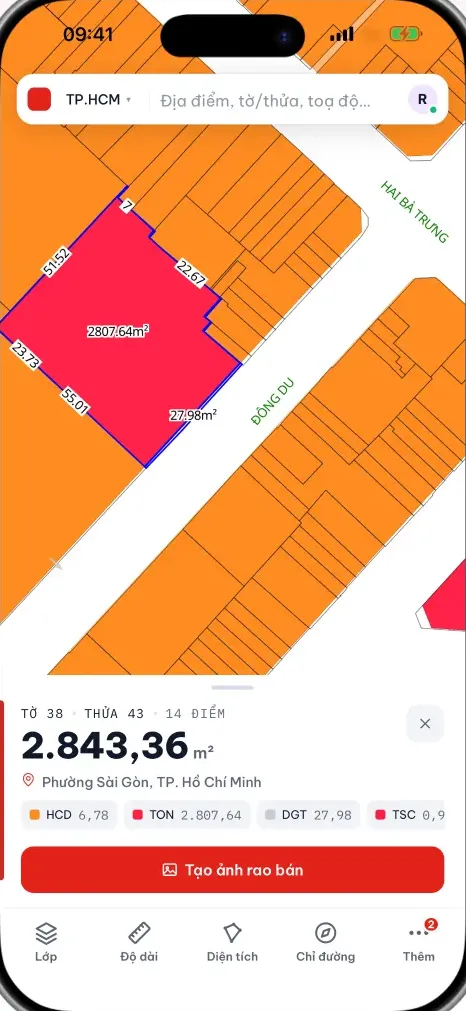
Open the Ankapong map, search by address or by VN2000 coordinates, and click the parcel. The panel shows the parcel's land-use classification and how it sits under the current zoning (planning) layer — so you can see at a glance whether a plot is residential, agricultural, or partly reserved for a road or public work before you go further.
Treat everything you read online — including this page — as a starting point. Before any transaction, verify the land-use purpose and planning status against the original certificate and an official cadastral extract from the local land office.
Frequently asked questions
Can I build a house on CLN (perennial-crop) land?
Not directly. CLN is agricultural land. To build legally you must first convert it to residential use, which requires approval and a land-use conversion fee — and it will only be granted if the parcel is zoned to allow residential use. Always confirm before buying.
Is the land-use code the same as the zoning/planning?
No. The code on the certificate is the current legal land-use purpose. The zoning (quy hoạch) map shows the intended future use. They can differ — for example a residential parcel that the master plan reserves for a road. You need to check both.
Can agricultural land be converted to residential?
Sometimes. It depends on the current zoning of that specific parcel and local land quotas. Wet-rice land (LUC) is the most restricted. The only reliable answer comes from the local land-use plan for that exact plot, not from a general rule.
What is the difference between the red book and the pink book?
They are older and newer names for the land / land-and-property certificate. Since 2009 a single unified certificate (commonly called the pink book) records land-use rights and any attached house. The land-use code appears on it.